Should You Use Epsom Salt for Tomatoes? Why It's Not a Great Idea
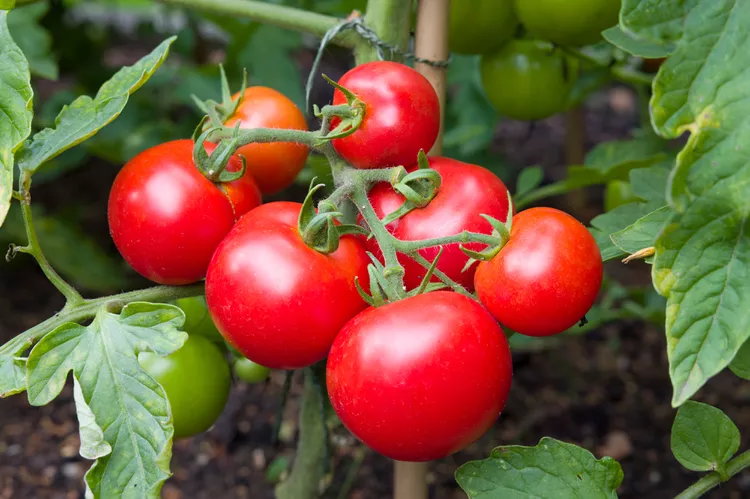
As one of America’s favorite vegetable crops, tomatoes seem to inspire gardeners to find creative ways to grow bigger, more flavorful fruits. One especially prevalent home remedy is Epsom salt, a common bath additive. But should you use Epsom salt for tomatoes? There's a healthy crop of controversy among gardeners and within social media groups about using Epsom salt for tomatoes so let's dig in to the facts with an expert to settle the question.
Linda Chalker-Scott is a horticulturist and an associate professor at Washington State University, as well as the author of several gardening books.
Problems with Using Epsom Salt on Plants
The common belief is that Epsom salt can act as fertilizer for your vegetable plants and even prevent the dreaded condition called blossom end rot in tomatoes. Like many garden myths, this one contains a grain of truth, offset by several contradictions.
Epsom salt, or magnesium sulfate, does contain magnesium and sulfur, both important plant nutrients. When your soil is deficient, amending can be helpful. However, experts say if used incorrectly, magnesium sulfate can have many unintended consequences. It shouldn’t be added to every tomato plant as a matter of course.
“Epsom salt should not be added unless a soil test indicates a deficiency in magnesium,” says Linda Chalker-Scott, a horticulturist and associate professor with Washington State University who has written several garden myth-busting books. “Adding too much of any nutrient can cause damage to soils and plants.”
In excess, magnesium sulfate can:
- cause nutrient imbalances in the soil
- lower the soil pH
- pollute groundwater
- hinder plant growth
- damage plant tissues
Epsom Salt
Epsom salt is magnesium sulfate (MgSO4), a naturally occurring mineral containing both magnesium and sulfur. The name comes from Epsom, England, a region known for spas whose waters are laden with magnesium sulfate.
Nutrients Tomatoes Need
Tomato plants are called “heavy feeders" because they require a lot of nutrients to grow. They thrive with plenty of nitrogen, phosphorus, and potassium as well as lesser amounts of calcium, magnesium, and sulfur, according to the U.S. Department of Agriculture.
Magnesium is an essential nutrient for vegetable plants and instrumental in chlorophyll formation. Leaves lacking magnesium show a distinctive yellowing (chlorosis) pattern in which the leaf tissue yellows on older leaves, while the veins stay green.
Sulfur helps tomato plants build proteins and develop that delicious flavor. Sulfur deficiencies, which present as yellowing of young leaves, are even more rare than magnesium deficiencies in U.S. soils.
With both nutrients, deficiencies are seen most in large-scale intensively planted farms–and that’s where we got the idea to use Epsom salt for tomatoes in the first place. According to a report by Chalker-Scott, farmers began applying magnesium sulfate to correct for “leaf blotch” in the 1940s, but research showed it had inconsistent results fixing the problem. Yet because spraying leaves with magnesium sulfate will “green up” the leaves temporarily, home gardeners turned to easily available Epsom salt.
Common Reasons for Using Epsom Salt for Tomatoes
Epsom salt is usually recommended as a fertilizer for planting, in a foliar spray to correct yellowing leaves, and to prevent or correct blossom end rot. Let’s look at each reason for using Epsom salt.
As a fertilizer.
When your soil is deficient, Epsom salt can be helpful as an amendment. But when it’s already present, adding magnesium sulfate forces nutrients to compete for access, allowing uptake of some and blocking others. Excesses can cause salt “burn” on your vegetable plant’s foliage too.
To fix yellowing leaves.
There are many reasons leaves turn yellow besides magnesium deficiency. Even if your soil is missing magnesium, spraying leaves with magnesium sulfate and water may turn your tomatoes’ leaves green for a bit, but it won’t address an underlying soil deficiency.
To cure blossom end rot.
It’s unclear how this myth of using Epsom salt for blossom end rot started. This problem shows up as dark squishy lesions on the bottom of your tomatoes–often in the earliest round of fruit. Once it starts, the rest of the fruit degrades. The lesions are caused by poor uptake of calcium triggered by inconsistent watering and sometimes planting in cool temperatures.
Not only does magnesium sulfate have no calcium, but even if it did, the plant couldn’t access it. Adding it doesn’t impact the watering issue and can further skew nutrient imbalances, making blossom end rot worse, according to North Dakota State University.
“Blossom end rot in tomatoes is due to inconsistent watering,” says Chalker-Scott, meaning too much and/or too little water over time. "Adding unnecessary nutrients does nothing to help.”
Alternatives to Using Epsom Salt for Tomatoes
Test your soil.
Magnesium deficiency in home gardens isn’t very common, it turns out. It is sometimes seen in very sandy and acidic soils and can be worsened by heavy rainfall leaching minerals from the soil.
Before adding Epsom salt for tomatoes, determine if your soil needs magnesium and/or sulfur so you don’t upset the balance in the soil. Soil tests by mail are usually offered by university or county extension offices.
“Gardeners should do a soil test and use the results as a guide for fertilizer application,” says Brooke Edmunds, Extension Horticulturist for Oregon State University. “[Epsom salt] can be used to correct soil deficiencies but only if the soil is deficient in magnesium or sulfur. It doesn’t contain any of the other nutrients that plants need (like NPK).”
Pay attention to macro- and micronutrients.
Standard fertilizers tend to offer mainly the big three macronutrients N, P, and K (which stands for nitrogen/phosphorus/potassium), but check the label for micronutrients also. Premium fertilizers usually contain more diverse ingredients. When looking for tomato fertilizer, the University of Missouri Extension office suggests a fertilizer ratio lower in nitrogen, high in phosphorus, and medium-high in potassium.
When growing tomatoes in containers or raised beds, consider using a higher-quality soil mix that includes minerals that supply magnesium and sulfur.
Water consistently.
To avoid blossom end rot, plant your tomatoes after soil temperatures are over 50°F at night, and water deeply and consistently. If the condition appears despite your best efforts, pick off the affected fruit (you can still eat the unblemished parts and save seeds for next year). Once watering becomes consistent, blossom end rot usually resolves itself for later fruit.